
Byline: lunyu.ai editorial desk · Review: lunyu.ai editorial desk
What Is a Junzi in the Analects?

When you search "what is a junzi," you usually want a checkable name, not a success slogan. In the Analects the junzi is a role of conduct and judgment—someone measured by learning, rightness, and how they hold themselves when unrecognized—not by office or pedigree. You can quote a short definition here, then open the lines themselves on this site and keep source, guide, and Legge's English in their layers.
A short answer you can quote
You can say it this way: a junzi is the person the book measures by conduct and judgment, not by rank. The name points to how you learn, how you weigh rightness against gain, and whether you stay steady when others take no note of you. It does not mean "successful person," celebrity, or a badge of birth. On this site the entity hub Junzi states the same spine in one line: a junzi may go unnamed and may be poor; what the name will not trade away is rightness for profit. You should treat that as a door into passages, not as a personality brand you wear.
Why the English glosses fight each other
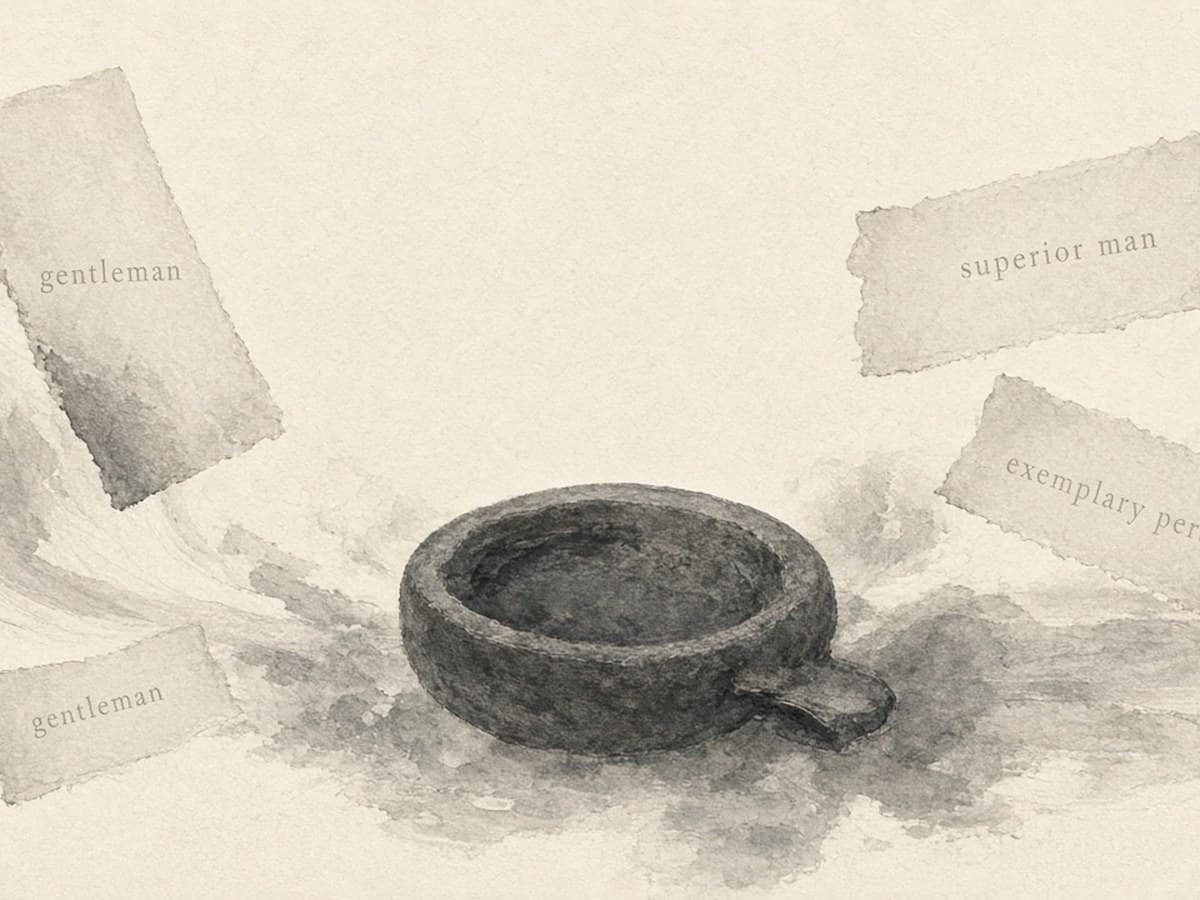
When you meet "gentleman," you inherit class manners and social polish the Chinese name does not require. When you meet Legge's "superior man," you easily hear social rank, even though many of his lines are about rightness, learning, and restraint. "Exemplary person" tries to dodge pedigree, yet it can sound like a modern role model poster. You do best to keep the romanization junzi in view, then read each English layer as a gloss—not as a replacement that settles the word once. Your check is always the live passage: source Chinese, modern guide, and public-domain Legge on the same page.
Three doors in the text
Not a vessel
One short line you should open first is Wei Chang 2.12. Legge gives: "The accomplished scholar is not a utensil." A vessel is a tool with one assigned use; the junzi is not stored as one office, one talent, or one function you hire and shelve. You can let that sentence stop a habit of reducing people—including yourself—to a single skill label. When you are ready to sit with the Chinese and the English together, that chapter is the main door on this Note.
Unmoved when unknown
The book's opening chapter, Hsio R. 1.1, places the junzi after "men take no note of him." Legge asks whether he is not "a man of complete virtue, who feels no discomposure though men may take no note of him." You are not given a how-to for fame management; you are given a first condition of the name: recognition is not the price of the title. Hold that lightly here—this Note only points the door; it does not rewrite a how-to-read essay. Your next move, if the line catches you, is the live chapter page, not a summary that invents extra numbers.
Right vs profit
Le Jin 4.16 sets the contrast on the measure you use, not on pedigree. Legge: "The mind of the superior man is conversant with righteousness; the mind of the mean man is conversant with gain." You can hear yi (rightness) against li (profit) as two ways of weighing a choice. When you ask what a junzi "is," this door answers by what the mind stays conversant with—not by wealth, office, or a villain cartoon of everyone else. Cite the live Le Jin page when you quote; do not float the number alone as if it were a slogan.
Junzi and xiaoren (contrast only)
You will often meet xiaoren paired with junzi. On this site that pairing marks a measure: profit, partiality, sameness without harmony, overflow in poverty—before it names a class insult or a cartoon villain. You should read the paired line first and refuse to turn "small person" into a social slur you throw at strangers. This section stops at contrast; it does not become a daily-habits handbook. If you want everyday ren and junzi conduct as practice, that is another Note on this site, not a rewrite of the definition question you brought here.
FAQ
What does junzi mean in the Analects?
You can quote this: a junzi is a role of conduct and judgment—learning, rightness, steadiness when unrecognized—not a status badge or a synonym for success. The book tests the name in scenes, not in a single dictionary box. Your shortest honest answer still sends you back to a passage URL on this site rather than to a motivational paraphrase.
Which English word is least misleading?
You should treat none as final. "Gentleman" smuggles class manners; "superior man" is easily heard as rank; "exemplary person" can sound like a poster. Keep junzi in the title of your question, then use Legge as one public-domain layer beside the Chinese. Your least-misleading move is the layered page, not a single English winner.
Is there one sentence that defines junzi?
You will not find one line that closes the name for every asker. Different disciples hear different items—act before speaking, be without anxiety or fear, cultivate with reverence—and the book opens by tying the junzi to learning and to being unmoved when unknown. Your "definition" is a cluster of doors, not a slogan you paste onto every career talk.
Can a junzi be poor or unknown?
Yes. The opening chapter already places the name after going unrecognized, and elsewhere the book allows firmness in want without canceling the title. You should not equate junzi with visibility, office, or comfort. Poverty or anonymity can still leave rightness untraded; that is part of what the name refuses to sell.
How is this different from "be a better person" advice pages?
You are reading a definition and passage-door Note, not a habit coach. This page maps the word, the fighting English glosses, and a few live Analects doors you can open. Everyday ren and junzi conduct belongs to Ren, Junzi, and Everyday Conduct—link once, do not rewrite it here. Your next check stays on source text, not on a second self-help outline.
Is the xiaoren simply a villain?
You should not flatten the pair that way. Xiaoren usually marks a contrast of measure—profit, partiality, conformity without harmony—before it names a villain. Read the paired line on the live pages; refuse a cartoon that turns half the book into insults. Your task is to notice which measure you are using, not to collect enemies from the Analects.
Where should you go next on this site?
Open the short "not a vessel" chapter as your first sitting text, then browse more junzi lines from the entity index when you want the wider map. You keep source, guide, and Legge visible together and refuse any newly minted Confucius quote. Your verification path is always a published URL on lunyu.ai.
Open the line, then the index
When you are ready to test the name against one short sentence, open The Analects · Wei Chang 2.12 and read source, guide, and Legge side by side. Ask whether you have been treating yourself—or someone else—as a single-use vessel. Then return to the Junzi index for more doors, and keep this definition Note separate from the everyday-conduct sister page.