
Byline: lunyu.ai editorial desk · Review: lunyu.ai editorial desk
Guan Zhong in the Analects
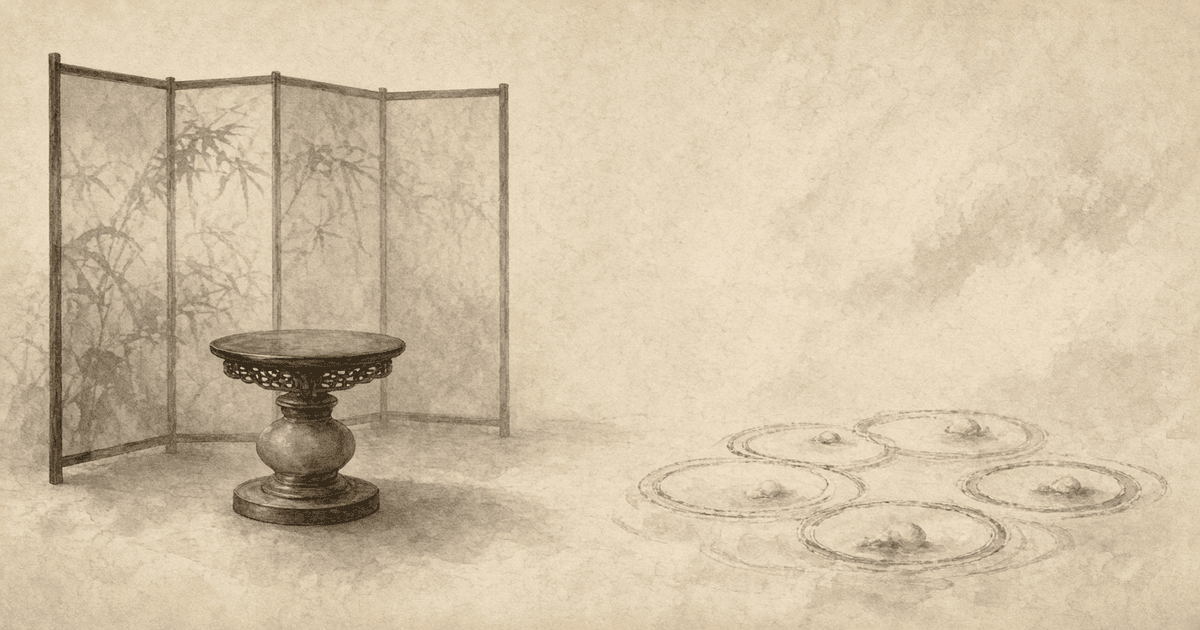
Guan Zhong in the Analects is the hard case — ritual overreach and a gift the people still feel, judged in the same voice. In the Analects, Guan Zhong (管仲; also 管氏; Legge often: Kwan Chung) is the famous Qi minister Confucius both cuts down and lifts up: small capacity, screens and stands that ape a prince, and yet nine meetings of the princes without weapons — “such was his ren.” This Note opens the four live passage doors on his index: the cut on capacity and propriety (3.22); the judgment “a man” beside the Po family’s silent endurance (14.10); Zi Lu’s challenge answered with 如其仁 (14.17); and Zi Gong’s challenge answered with 微管仲 and the people’s lasting gift (14.18). It is not a Qi politics novel, not a rewrite of the Duke Jing of Qi Note, not a rewrite of Li Ritual, not a rewrite of What Ren Means, not a rewrite of the Zi Lu or Zi Gong Who Notes, and not a rewrite of Bo Yi and Shu Qi via 「谅」. The index already gathers the cluster; here you deepen those four doors.
Small capacity, screens, and stands — 管仲之器小哉
Start with The Analects · Pa Yih 3.22. The source: 子曰,管仲之器小哉。或曰,管仲俭乎。曰,管氏有三归,官事不摄,焉得俭。然则管仲知礼乎。曰,邦君树塞门,管氏亦树塞门,邦君为两君之好,有反坫,管氏亦有反坫,管氏而知礼,孰不知礼。
The modern guide on that page: 孔子说:管仲的器量真小啊!有人说:管仲是不是很节俭呢?孔子说:管仲有三处豪华的府第,家臣各司其职从不兼任,怎么谈得上节俭?那人又问:那么管仲懂礼吗?孔子说:国君在门口设立屏墙遮挡视线,管仲也在门口设立屏墙;国君为招待别国君主设有放置酒杯的土台,管仲也设有这样的土台。管仲若算懂礼,那还有谁不懂礼呢?
Legge on the same page: 1. The Master said, "Small indeed was the capacity of Kwan Chung!" 2. Some one said, "Was Kwan Chung parsimonious?" "Kwan," was the reply, "had the San Kwei, and his officers performed no double duties; how can he be considered parsimonious?" 3. "Then, did Kwan Chung know the rules of propriety?" The Master said, "The princes of States have a screen intercepting the view at their gates. Kwan had likewise a screen at his gate. The princes of States on any friendly meeting between two of them, had a stand on which to place their inverted cups. Kwan had also such a stand. If Kwan knew the rules of propriety, who does not know them?"
Take the hinge carefully. The cut falls on 器小 — small capacity — then on economy denied by 三归 and undivided offices, then on propriety: 塞门 and 反坫 that copy a prince. You are given a ritual-overreach door, not a full Li Ritual essay, and not a Qi court novel. Open this lead door; stay on the screens and stands.
“A man” — and a silence that lasts — 人也
Open The Analects · Hsien Wan 14.10. The source: 或问子产,子曰,惠人也。问子西。曰,彼哉彼哉。问管仲。曰,人也,夺伯氏騈邑三百,饭疏食,没齿,无怨言。
The guide: 有人问子产是怎样的人。孔子说:是个给人恩惠的人。又问子西。孔子说:他呀,他呀!又问管仲。孔子说:他是个人才。他剥夺了伯氏骈邑三百户的采地,使伯氏只能吃粗粮,可伯氏直到老死,也没有一句怨恨的话。
Legge: 1. Some one asked about Tsze-ch'an. The Master said, "He was a kind man." 2. He asked about Tsze-hsi. The Master said, "That man! That man!" 3. He asked about Kwan Chung. "For him," said the Master, "the city of Pien, with three hundred families, was taken from the chief of the Po family, who did not utter a murmuring word, though, to the end of his life, he had only coarse rice to eat."
Read only this judgment door. Someone asks in a row; Zi Chan is kind, Zi Xi is waved aside, and Guan Zhong is called 人也 — “a man” / a real talent — beside the Po chief’s lifelong silence after losing 騈邑三百. This Note opens one character-judgment door. It does not become a Qi land-and-office history, and it does not rewrite other people Notes named only as foils.
Zi Lu’s challenge — 如其仁
In The Analects · Hsien Wan 14.17 Zi Lu presses the death that Guan Zhong did not die. The source: 子路曰,桓公杀公子纠,召忽死之,管仲不死。曰,未仁乎。子曰,桓公九合诸侯,不以兵车,管仲之力也。如其仁。如其仁。
The guide: 子路说:桓公杀了公子纠,召忽为此自杀殉主,管仲却没有死。这样看来,管仲算是没有仁德吧?孔子说:桓公多次会合诸侯,不靠武力,都是管仲的功劳。这就是他的仁德,这就是他的仁德。
Legge on the same page (live English body opens with Zi Lu’s charge): 1. Tsze-lu said, "The Duke Hwan caused his brother Chiu to be killed, when Shao Hu died with his master, but Kwan Chung did not die. May not I say that he was wanting in virtue?"
Stay on the hinge the source and guide complete: Zi Lu asks 未仁乎; the answer turns to 桓公九合诸侯,不以兵车,管仲之力也 and doubles 如其仁. Duke Huan and Shao Hu appear only as the door’s frame — not as a Qi politics novel, and not as a rewrite of the Zi Lu Who Note. Soft-avoid expanding this into What Ren Means; here 如其仁 is a historical-judgment mark on Guan Zhong’s force without war-carts.
Zi Gong’s challenge — 微管仲
Open The Analects · Hsien Wan 14.18. The source: 子贡曰,管仲非仁者与。桓公杀公子纠,不能死,又相之。子曰,管仲相桓公,霸诸侯,一匡天下,民到于今受其赐,微管仲,吾其被发左衽矣。岂若匹夫匹妇之为谅也,自经于沟渎,而莫之知也。
The guide: 子贡说:管仲不能算是有仁德的人吧?桓公杀了公子纠,管仲不但不能为公子纠殉死,反而去辅佐桓公。孔子说:管仲辅佐桓公,称霸于诸侯,匡正了天下,百姓到今天还享受着他带来的好处。如果没有管仲,我们恐怕都要披散头发、衣襟向左开,沦为夷狄了。难道要他像普通百姓那样守着小节小信,在山沟里自杀,却没有人知道,才算好吗?
Legge on the same page: 1. Tsze-kung said, "Kwan Chung, I apprehend, was wanting in virtue. When the Duke Hwan caused his brother Chiu to be killed, Kwan Chung was not able to die with him. Moreover, he became prime minister to Hwan." 2. The Master said, "Kwan Chung acted as prime minister to the Duke Hwan, made him leader of all the princes, and united and rectified the whole kingdom. Down to the present day, the people enjoy the gifts which he conferred. But for Kwan Chung, we should now be wearing our hair unbound, and the lappets of our coats buttoning on the left side. 3. "Will you require from him the small fidelity of common …
Stay on the historical-gift door. Zi Gong asks 非仁者与; the answer names 霸诸侯,一匡天下, the people’s lasting gift, and 微管仲,吾其被发左衽矣 — without him, unbound hair and left-lapping coats. The closing edge refuses to measure him only by 匹夫匹妇之为谅 and a nameless ditch-death. Soft touch only: this is not a rewrite of the Zi Gong Who Note, not a rewrite of What Ren Means, and not a rewrite of Bo Yi and Shu Qi via 「谅」.
What the four doors add up to
Put them together and you have: capacity and propriety cut down by 器小, 塞门, and 反坫 (3.22); a man judged beside a lifelong silence after taking 騈邑三百 (14.10); Zi Lu answered with nine meetings without weapons and 如其仁 (14.17); Zi Gong answered with the people’s gift and 微管仲 (14.18). The Note deepens those doors; it does not retell the index line that already calls him a famous statesman used to discuss achievement, ren, and historical judgment, and it does not inventory passages beyond the four on that index.
This is also not a Qi politics / Duke Huan biography novel, not a rewrite of Duke Jing of Qi in the Analects, not a rewrite of Li Ritual via 3.22, not a rewrite of What Ren Means via 14.17–18, not a rewrite of Zi Lu or Zi Gong Who Notes (their questions are doors only), and not a rewrite of Bo Yi and Shu Qi via 「谅」. False friends — treating Guan Zhong as a hero to copy, a villain to discard, or a management tip list — are not this Note’s work.
As your own reflection — not as Confucius’s words — you may want to keep only the screens-and-stands cut, or only the nine-meetings praise. The Analects can place ritual overreach and a gift the people still feel in one person, judged in the same voice. The harder edge in these doors is the hard case itself: failure of propriety and historical gift sitting together, without collapsing either side.
FAQ
Who was Guan Zhong in the Analects?
Guan Zhong (管仲; Legge often: Kwan Chung) is the Qi minister the book both cuts down and lifts up. Live doors show screens and stands that ape a prince (3.22); “a man” beside the Po family’s silence (14.10); 如其仁 without war-carts (14.17); and 微管仲 with the people’s gift (14.18). Check each quote on its passage page and say whether you used the source, the guide, or Legge.
What does 管仲之器小哉 mark in 3.22?
Small capacity — then economy denied by San Kwei and undivided offices, then propriety denied by 塞门 and 反坫 that copy a prince. This Note reads that as the lead ritual-overreach door; it is not a full Li Ritual essay, not a Qi court novel, and not a tip on frugality.
Why keep 如其仁 as a Guan Zhong door, not a ren essay?
Here 14.17 is only the historical-judgment door: Zi Lu charges want of virtue; the answer turns to force that gathered the princes without war-carts and doubles 如其仁. What Ren Means already covers broader ren reading; this Note does not rewrite it, and it does not rewrite the Zi Lu Who Note.
What does 微管仲 open in 14.18?
Without Guan Zhong, the Master says, we should be wearing hair unbound and coats lapping left — and down to the present day the people enjoy his gifts. Stay on that civilizational-scale gift door; soft-avoid turning 谅 into a Bo Yi rewrite, and soft-avoid rewriting the Zi Gong Who Note.
Is Guan Zhong a hero to copy or a villain to discard?
Neither. In these four doors he is the hard case: ritual overreach (3.22) and a gift the people still feel (14.17–18), judged in the same voice. The Note returns you to the live passages rather than handing you a hero cult or a tip list.
Does 14.10 praise seizure of land?
It names him 人也 and marks that the Po chief, reduced to coarse rice, uttered no murmuring word to the end of life. Read the judgment and the silence as the live page gives them; do not expand into a Qi land-office history or a management case study.
After FAQ — open the Guan Zhong index
When you want the passages that name this hard case gathered on one screen, open Guan Zhong. The index selects those doors; this Note followed the screens-and-stands cut, the “a man” judgment, 如其仁 without war-carts, and 微管仲 with the people’s gift. Read them again there, and when you quote, give the passage URL and say whether you used the source, the guide, or Legge.